Textiles Experiment
Biodegradation of Textiles: Acetate, Nylon and Cotton
This lab is analyzing biodegradation and the physical aspects that are impacted in regards to sustainability of one natural textile (cotton), and two manmade textiles (acetate and nylon).
In my lab, I am comparing and contrasting Velvet ( 65% acetate and 35% nylon) to Velveteen (100% cotton).
Definition of Biodegradation
“Degradation is a process of breaking down a material into its constituent elements by a physical, chemical, or a biochemical process which should be irreversible. When this process of degradation is aided by the attack of living matter especially microorganisms, resulting into mineralization of biomass, it becomes Biodegradation” (Van der Zee, M, Stoutjesdijk, J.H., Van der Heijden, P.A.A.W. and De Wit, D, 1995)
Adopted from the Swedish School of Textiles University of Boras 2011
Hypothesis
My own hypothesis for this lab is that Velveteen will degrade or decompose at a faster rate as opposed to velvet throughout the testing period of 77 days.
The Process


Conclusion
Was my hypothesis accepted or not accepted?
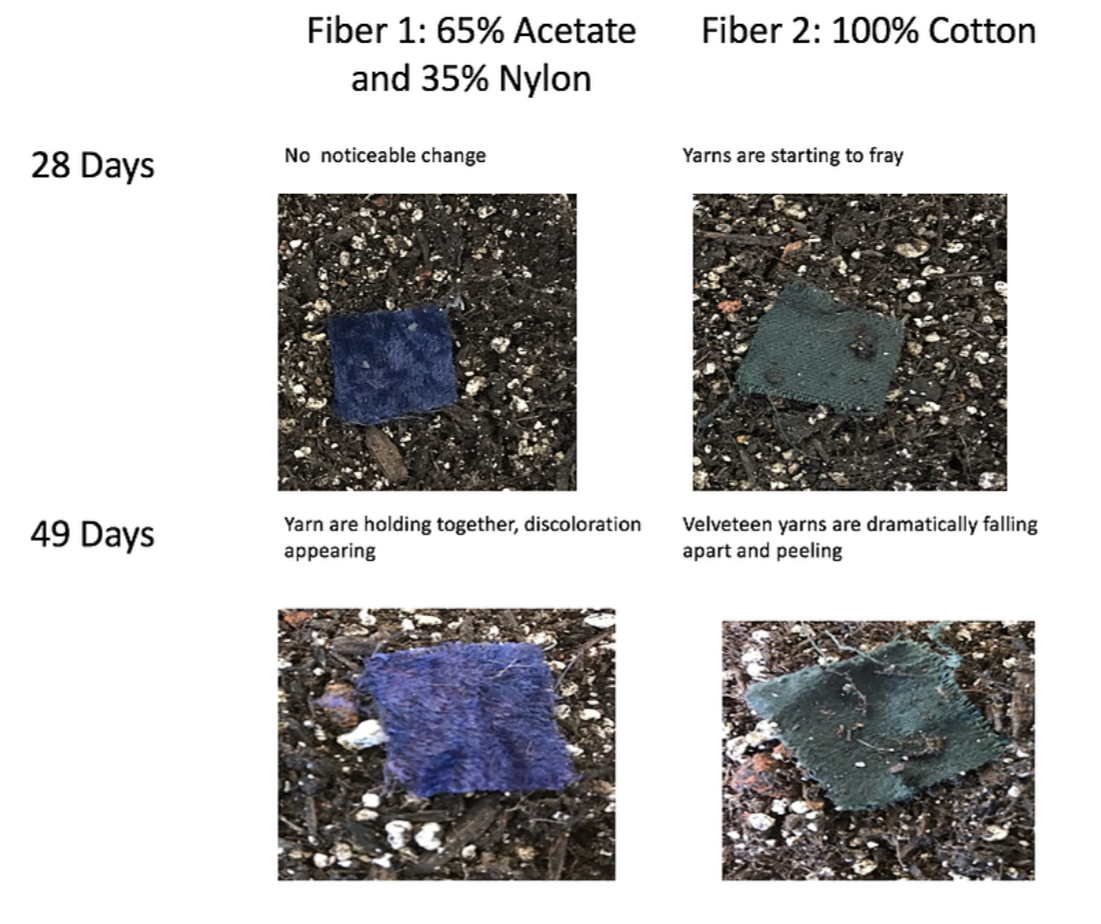
Apart of my hypothesis was that Velveteen would biodegrade at a faster rate as opposed to Velvet. Because velveteen is a natural cellulosic fiber, it would be better recommended to use in textiles or for fabrics because it is less harmful to the environment. According to my results, at the end of the lab experiment, both textile fibers still remained. The velveteen started to appear to decompose at a faster rate due to how much the yarns were fraying at the ends. The Velvet fabric still frayed, but at a slower pace. The velvet had discoloration towards the end.
I accept my hypothesis, because with more time, the Velveteen fabric would decompose completely as opposed to the velvet which would fray, but still be in the soil which is harmful to the environment.